
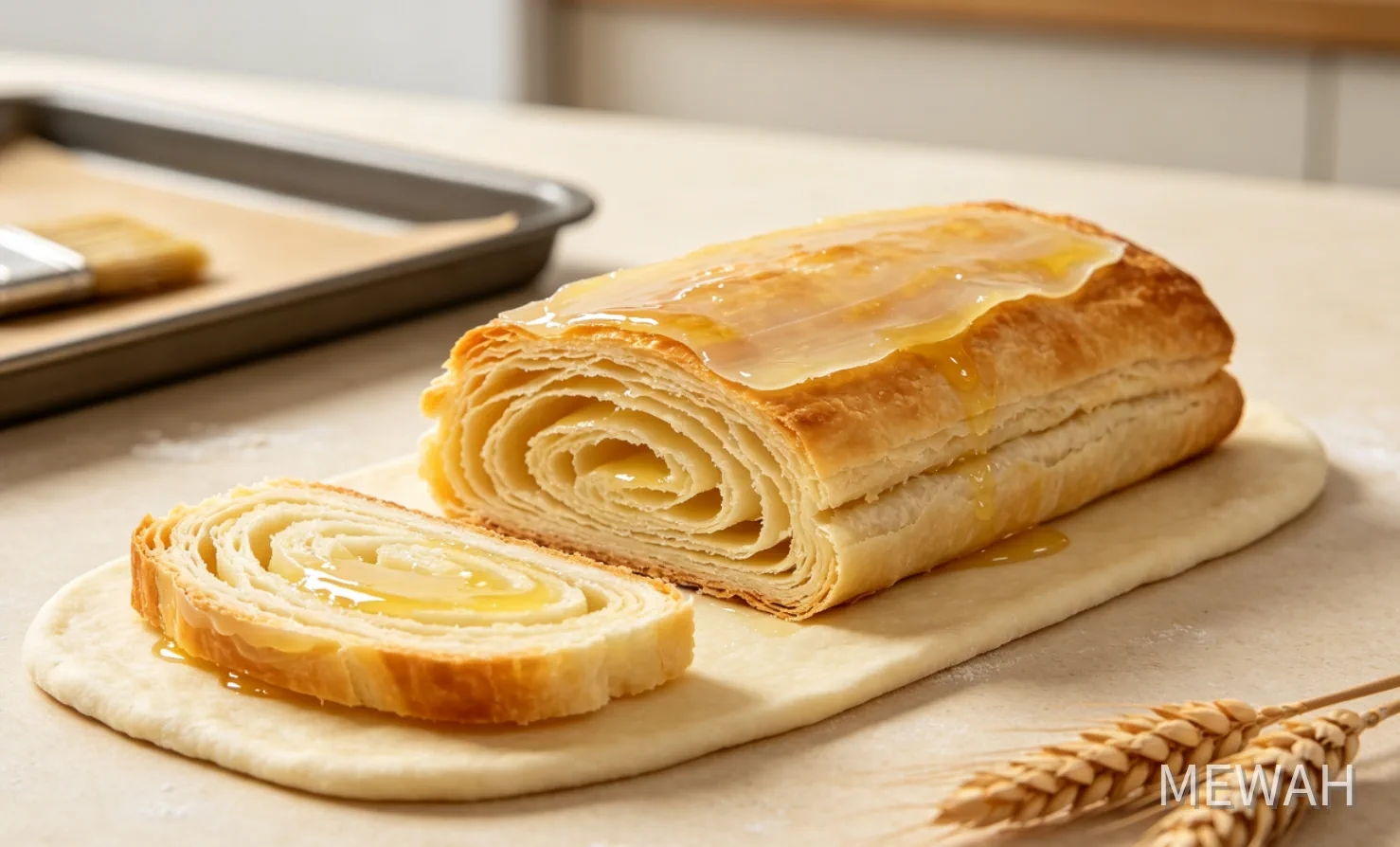
Lamination comes down to keeping a continuous, unbroken film of fat between layers of dough. In the oven the water in that fat turns to steam and pushes the dough layers apart, which is what creates the lift. If the fat has already shattered into fragments or bled into the dough during sheeting, there is nothing left to separate the layers.
The variable is not hardness, it is the plastic range
Firmness is the usual shorthand, but what actually governs workability is the plastic range — the temperature window in which the fat deforms without flowing. A fat with a narrow window swings from too firm to too soft on a two- or three-degree drift in room temperature; only a wide window tolerates the fluctuation real production involves. This is why the solid-fat-content curve tells you far more than a single melting-point figure.
Choose against your room temperature
- Room at 16 – 20 °C: slip melting point 34 – 36 °C, a supple fat giving fine layers
- Room at 20 – 24 °C: slip melting point 36 – 38 °C, the usual choice
- Room at 24 – 28 °C, or summer production: slip melting point 40 – 43 °C, to avoid bleeding and roller pick-up
- Frozen dough: brittleness at low temperature also matters, so sample it specifically
One caveat: room temperature means the measured temperature at the sheeting bench, not the air-conditioning setpoint. A gap of three degrees or more between the two is common, particularly on lines where equipment throws off heat. Log the bench temperature across a full shift before settling on a formulation.
Telling us your measured bench temperature is more useful than telling us your target specification.